
For most flat roofs around the Chicago area, TPO is the default pick: a white membrane with welded seams at a fair cost. EPDM is the choice when cold weather flexibility and a long track record count most.
PVC is the membrane for buildings where grease, oil or chemicals reach the roof, like a restaurant. If your building has none of that, TPO or EPDM often does the same job for less.
We install all three, plus roof coatings, on commercial buildings across Chicago and the surrounding suburbs. Here is how we explain the choice to building owners and property managers.
What do TPO, EPDM and PVC have in common?
All three are single ply membranes. Each one goes down in large sheets across a flat or low slope roof, over a layer of insulation.
Each can go on in one of three ways. It can be glued down fully, fastened through the insulation to the deck, or laid loose and weighed down with stone or pavers.
On all three, the seams are where a roof usually fails. How well the crew joins the sheets decides how long the roof lasts.
What is TPO roofing?
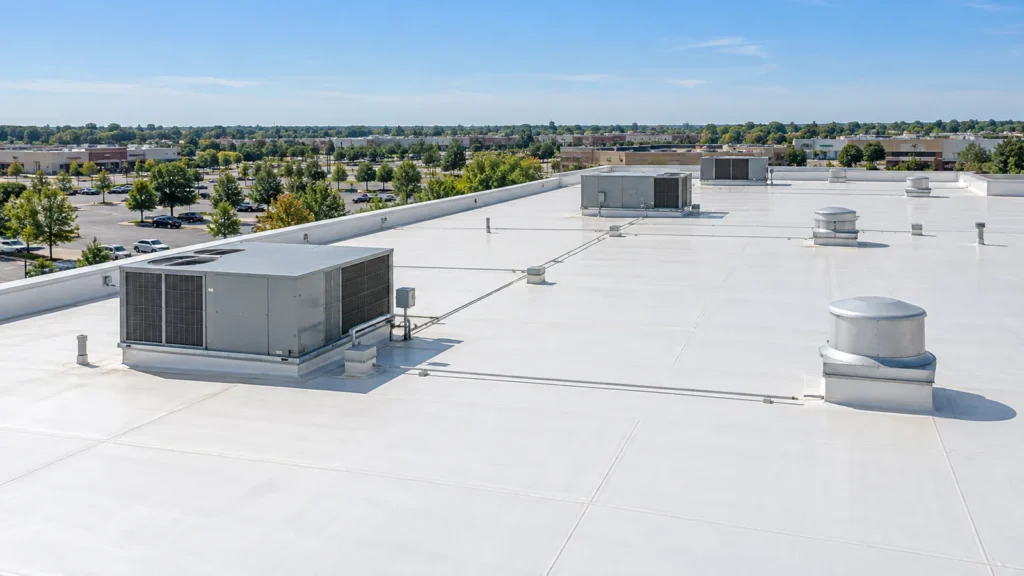
TPO stands for thermoplastic polyolefin. It comes in white and light colors, which bounce sunlight away from the building and lower the cooling load in summer.
The sheets are joined with hot air welding, which fuses the edges into one continuous waterproof sheet. A properly welded TPO seam is one of the stronger joints in commercial roofing.
TPO flexes across temperature swings without cracking. It also takes a hail hit better than rigid materials do, because it gives a little on impact.
What is EPDM roofing?
EPDM is a synthetic rubber membrane. Its full name is ethylene propylene diene monomer, and it has been on flat roofs across the country for decades.
Standard EPDM is black and soaks up heat. On a building that pays more to heat than to cool, that can help in winter. White EPDM is an option when cooling costs come first.
EPDM seams are joined with seam tape or adhesive instead of heat. Done by an experienced crew with the right products, those seams perform well for a long time. EPDM is also one of the easier membranes to repair.
What is PVC roofing?
PVC stands for polyvinyl chloride. The membrane is reinforced with a polyester or fiberglass scrim, which adds strength and tear resistance.
Like TPO, PVC seams are welded with hot air. A good PVC weld becomes part of the membrane itself, so the seam is among the strongest you can get.
The big reason to pick PVC is grease. Cooking grease damages EPDM and can break down TPO over time, and PVC stands up to grease, animal fats, oils and many industrial chemicals.
How does each one handle a Chicago winter?
Freeze and thaw is hard on any flat roof. Each swing above and below freezing works on the seams and on every spot where something comes through the roof.
EPDM is the most flexible of the three in deep cold. That rubber makeup is the main reason it has lasted so long as a choice in cold climates.
TPO handles the swings well, and its welded seams handle the roof growing and shrinking better than glued ones. PVC gets stiffer in the cold, so it is best installed when the weather cooperates.
How do TPO, EPDM and PVC roofing compare side by side?
| TPO | EPDM | PVC | |
|---|---|---|---|
| What it is. | Thermoplastic single ply. | Synthetic rubber. | Reinforced thermoplastic. |
| Color. | White or light. | Black, or white. | Usually white or light gray. |
| Seams. | Hot air welded. | Tape or adhesive. | Hot air welded. |
| Deep cold. | Flexible across swings. | Most flexible of the three. | Stiffer, install with care. |
| Grease and chemicals. | Can break down over time. | Damaged by cooking grease. | Resists grease, oil and many chemicals. |
| Repairs. | Weld in a patch. | One of the easiest to repair. | Weld in a patch. |
| Best fit. | Most flat roofs. | Cold climate, long track record. | Restaurants and food plants. |
Which one fits your building?
Pick PVC if grease, oil or chemicals land on the roof. Restaurants, food processing plants and some manufacturing buildings fall into this group.
TPO makes sense for most other buildings. You get a reflective roof with welded seams, and it does the job well at a fair cost.
EPDM is worth a look when a long record in the cold counts most to you. It also fits a building where cooling costs are low and a black roof helps in winter.
The existing roof shapes the choice too. The current system, the condition of the deck and any drainage problems all affect what can go on top.
When is a coating the better route?
Some roofs do not need a new membrane at all. If the roof is structurally sound and only the surface has worn down, a fluid applied coating can restore the waterproofing without a tear off.
A coating costs less than a replacement and sends less waste to the landfill. It is not right for every roof, so we check the existing system and the deck before we recommend it.
How do we help you choose?
We get on the roof, look at the building’s use, the existing system and the deck, and walk you through the options. You get a written scope before any work starts.
We are licensed, bonded and insured for commercial work, and we put the recommendation in writing either way.
Our commercial roofing systems page lays out the four systems we install, TPO, EPDM, PVC and coatings, with the trade offs for each. Call (224) 518-0278 to book a free inspection of your roof.