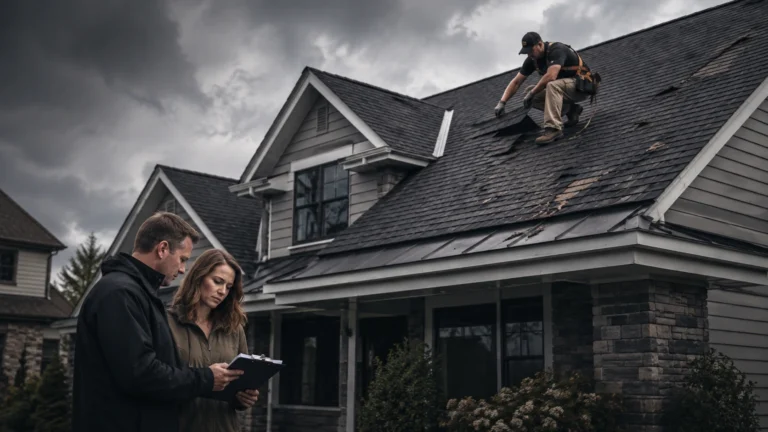

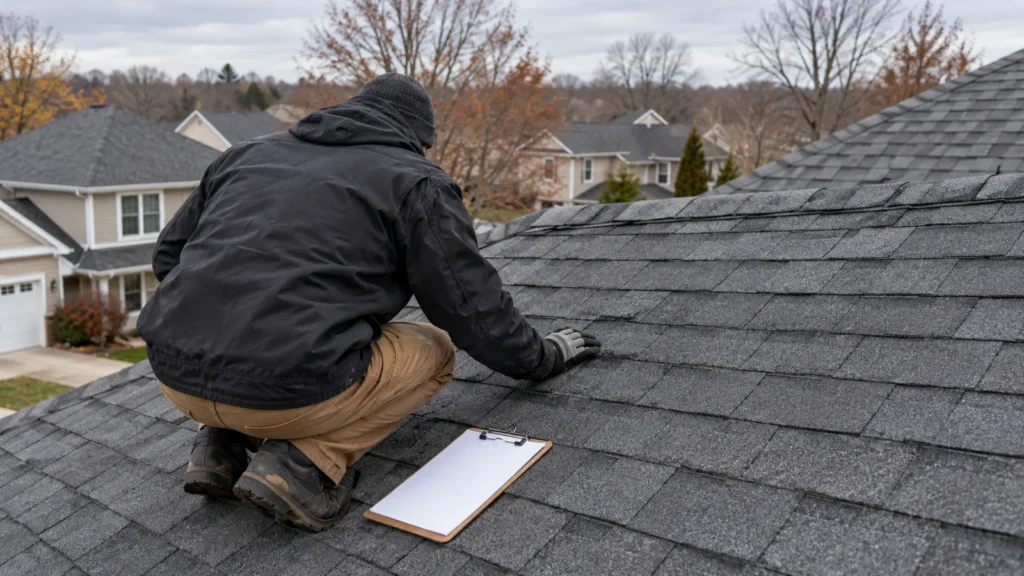
An adjuster looks for damage from the storm on your claim, and sorts it from age and wear. They check the shingles for hail hits and wind damage, the metal parts for dents, and the roof as a whole for signs of age.
What they write down decides what the insurer pays for. So it helps to know what they are looking at before they climb the ladder.
What is the adjuster trying to decide?
Two things. First, did a covered event cause the damage? Second, how much repair or replacement does that damage call for?
Standard homeowners policies around here cover storm damage from covered weather, usually hail, wind and lightning. They usually exclude wear and tear, maintenance problems and damage from before the storm.
So the adjuster draws a line between storm damage and everything else. Most disagreements about a claim come down to where that line goes.
How does an adjuster check for hail damage?
They look at the shingles up close, slope by slope. A hail hit on an asphalt shingle shows up as a dark spot where the granules got knocked off.
Many hits also leave a bruise. Press on it and the mat under the granules feels soft, like a bruise on an apple.
Adjusters often chalk a square on each slope and count the hits inside it. Each insurer sets its own rule for how many hits it takes to call a slope damaged.
They also look at the pattern. Hail hits land at random, in no line or grid. Marks in neat rows or only along the walking path usually point to something other than hail.
How does an adjuster check for wind damage?
Wind damage looks different. The adjuster looks for missing shingles, shingles that lifted and creased, and seal strips that let go.
A creased shingle has a line across it where the wind folded it back. Even if it lies flat again, the crease means it lifted and the seal broke.
They also check the flashing and ridge caps, which take the most wind. Damage that faces the direction the storm came from supports the claim.
Why does the adjuster look at gutters, vents and siding?
Soft metals dent easily, and the dents prove a storm came through. Hail leaves marks on gutters, downspouts, roof vents, flashing and the fins on an air conditioner.
The size and spread of those dents help the adjuster judge how big the hail was. They back up what the shingles show.
Hail that hit the roof usually hit the siding and gutters too. When damage to them comes from the same event, it usually belongs in the same claim.
How does an adjuster tell storm damage from old wear?
They look for the signs of age. Common ones are granule loss spread evenly across the whole roof, curled or cracked shingles and blisters from heat.
Old repairs, patched spots and moss also tell a story. So does a second layer of shingles laid over the first.
Damage that was there before the storm is excluded. That is why it helps to have a contractor who can point to each spot and explain why it is new.
What else goes into the adjuster’s report?
The report lists the roof size, the number of slopes, the pitch and how many layers of shingles are on it. It also notes any leaks inside and the date of loss.
Your policy decides how the number gets worked out. Some pay cash value, which takes off for the age of the roof. Others pay replacement cost, which covers the cost to replace it with similar materials.
If your roof is older and the policy pays cash value, the check may not cover a full replacement. Ask your insurance agent which kind your policy has.
How should you get ready for the adjuster visit?
Get the roof inspected and documented before the adjuster comes. Photos and written notes for every area of damage give the adjuster less room to guess.
Write down the date of the storm. Policies in our area have time limits for filing, so do not wait months to call.
Have your roofing contractor on the roof for the visit. An adjuster who sees the roof alone can write off storm damage as wear.
What happens if the adjuster comes back low?
It happens often, and it is not the end of the claim. A low report usually means something got missed or got called wear.
The answer is the documentation, one item at a time. A claim with clear photos and a written scope behind it gets revised far more often than one without.
How do we help with the adjuster?
We inspect the roof, siding and gutters for free and document every area of damage with photos and written notes. That report is what a claim is built on.
When the adjuster comes, we are there. We walk them through what we found and answer questions about the scope and the materials. If the number comes back lower than our documented scope, we work through it with you.
The inspection is yours to use however you choose, and you are under no obligation to hire us because we did it. Our roof insurance claim page walks through each step we handle, from the first inspection to the finished work. Call or text (224) 518-0278 to set up your inspection.