
If the damage is in one area and the rest of the shakes are sound, repair it.
If shakes are splitting, cupping and going soft across the whole roof, you are past repairs. Patching one section moves the next problem somewhere else.
Cedar works differently from asphalt here, and that trips people up. An asphalt roof wears out all at once. Cedar wears one shake at a time, so a cedar roof can look bad and have years left, or look fine and be nearly finished.
Why is cedar harder to judge than asphalt?
Because cedar is a living material and it never wears evenly.
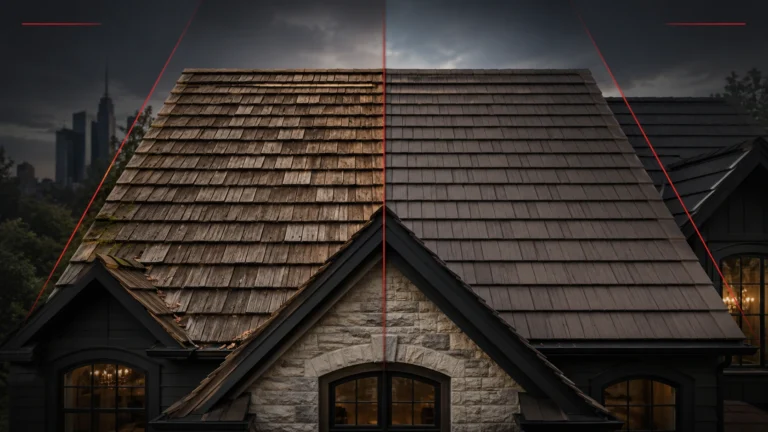
The shaded side under the trees traps moisture far longer than the sunny side. That face grows moss and algae, dries out slowly and gives up years earlier. The south face on the same house may be in good condition.
So a cedar roof is rarely all good or all bad. The question is how much of it does its job today, and whether the failures are a section or a pattern.
What do we look for up there?
Six things, across the whole roof instead of the spot you called about.
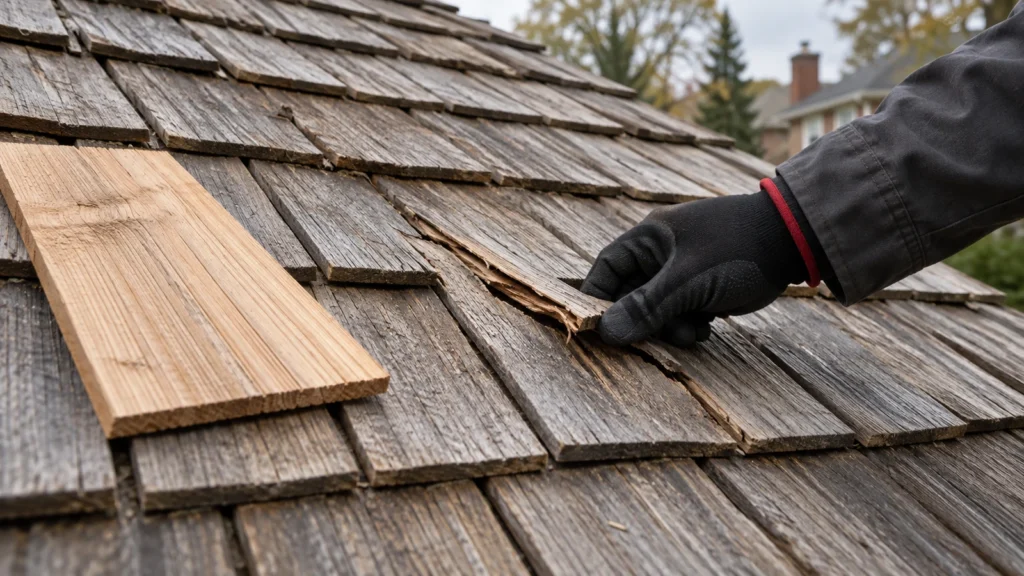
- Splitting. A few split shakes are normal and get swapped out. Splits across every face mean the wood is finished.
- Cupping and curling. Shakes that lift at the edges stop shedding water properly and let wind underneath.
- Soft spots. A shake that gives when you press it has rot, and rot spreads into whatever is beneath it.
- Moss, algae and lichen. All three trap moisture against the wood and speed up wear. In shaded spots they take over fast.
- Valleys and flashing. Cedar often outlives the metal around it. Sometimes the wood is fine and the flashing is the whole problem, which is a much smaller job.
- The decking underneath. If water has been getting through for a while, the wood under the shakes tells you more than the surface does.
When is a repair the right call?
Repair when the trouble is local and the rest of the roof passes the checks above.
Storm damage is the clearest case. Wind takes shakes off one slope, or a branch comes down and breaks a section, and the wood around it is sound. You replace what broke and move on.
Flashing failure is the other common one. Leaks around a chimney, a skylight or in a valley often have nothing to do with the shakes.
One warning worth having in advance: new cedar next to weathered cedar does not match, and it will not match for a few years. It starts light and weathers toward the rest of the roof slowly.
On a side elevation nobody notices. On the front of the house, people do.
When is it time to replace?
Replace when the wear is a pattern instead of a place.
Split and cupped shakes on more than one face, soft wood on several slopes, or leaks in several spots all point the same way. The system is worn out instead of damaged, and every repair after that buys less time than the one before it.
Repeat visits are the other trigger. If we have been out twice in two years and a third list is forming, stop. The money is going into a roof that already told you what it is doing.
Does a maintenance plan change the answer?
On cedar it changes the answer more than on any other material.
Cedar does best with periodic cleaning to stop moss, algae and lichen, plus wood preservative treatments on a schedule. Add a look twice a year for split or cupped shakes, failed flashing and debris in the valleys.
A cedar roof with that care behind it repairs well long past the point where a neglected one comes off. If yours is somewhere in the middle, catching it now often turns a replacement conversation into a repair and a care plan.
Can you match an older cedar roof?
This comes up on larger and older homes where cedar is the material the architecture was built around.
Partial replacement is possible, and sometimes it is the right answer, for example when one elevation took storm damage and the others are sound. It needs planning instead of improvising, because the exposure and the coursing on the new section have to line up with what is already there.
What to do next
Do not decide this from the ground, and do not decide it off one leak. Get someone on the roof who works with cedar specifically, and ask for photos of all of it, not only the spot that is leaking.
That is how we handle it. We get up there, photograph what we find, and show you the whole picture before anyone talks about a number. If the roof has years left in it, we will say so.
Our cedar shake roofing page walks through how we install the material and how we care for it. Call or text us and we will come out and take a look.