
Gutter guards in winter do one job well. They stop fall leaves from packing the gutter, so the trough is open when the first freeze comes.
They do not stop ice dams. An ice dam starts with heat from the attic, and nothing on the gutter can change that.
So guards help in the cold, within limits. Here is what they do, where they fall short, and what to watch for on your own roof this winter.
What do gutter guards do?
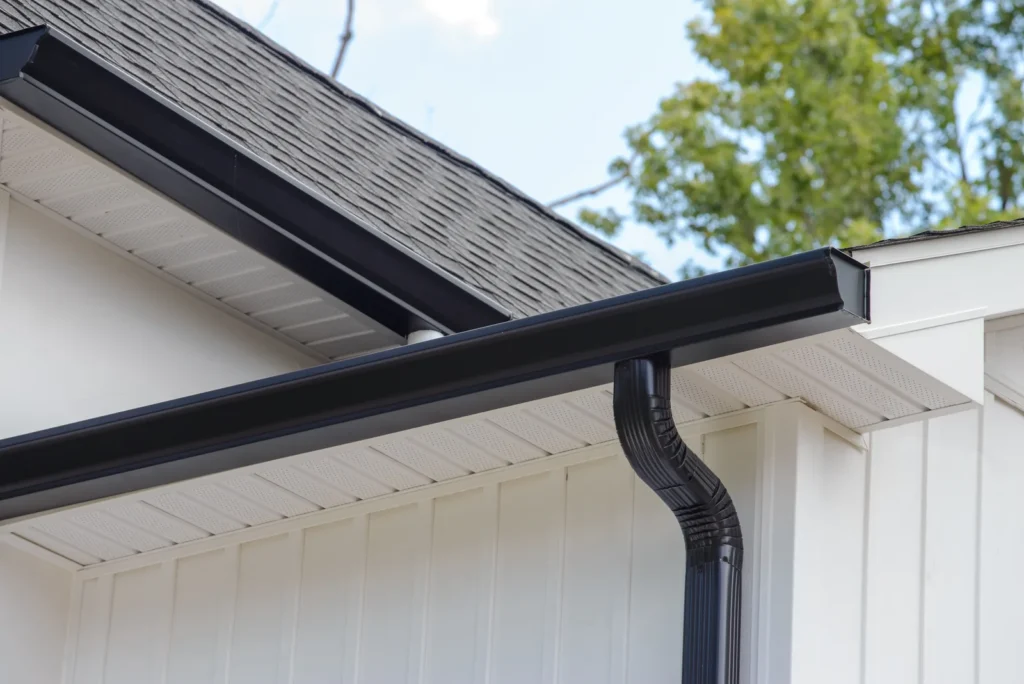
A gutter guard is a cover or an insert that fits over the open top of the gutter. Its job is to cut down how much debris gets into the trough.
Leaves, twigs and seed pods land on the guard instead of inside the gutter. Rain then flows through or around the guard and down the spout.
On a lot with big trees, that means far fewer cleanings each year. A home on an open lot with few trees gets less out of them.
What happens to gutter guards in winter?
Snow lands on top of the guard and on the roof above it. On a mild afternoon some of that snow melts, and the water flows into the gutter like rain.
On a cold night, water left on top of the guard can freeze there. A thin crust of ice can form over the cover or the openings.
When that happens, the next round of melt water has nowhere to go but over the front edge. That is where icicles come from on many homes with guards.
Inside the trough, water can freeze too, guard or no guard. A gutter packed with ice is heavy, and that weight pulls on the hangers.
Our winters swing above and below freezing again and again. Each swing gives the water another chance to melt, flow and freeze on the roof edge.
Do gutter guards stop ice dams?
No. A guard covers the gutter, and an ice dam forms on the roof just above it.
Heat from inside the house warms the attic and the roof boards. Snow melts on the warm part of the roof, flows down to the cold edge, and freezes again.
That ridge of ice traps more melt water behind it. The water backs up under the shingles, well above the gutter and the guard.
The fix for ice dams starts in the attic, with air sealing, insulation and good ventilation. A guard on the gutter does not touch any of those.
Be wary of any sales talk that calls guards an ice dam cure. A guard can help the gutter drain on a mild day, and that is about all it can do for a dam.
Can gutter guards cause problems in winter?
They can, in a few ways.
- Ice can form on top of a cover and send melt water over the edge.
- A heavy load of snow and ice can bend a guard or pull the gutter down with it.
- Snow sliding off the roof, or a roof rake pulled hard over the edge, can bend a guard or loosen it.
Guards do fine in winter when the guard and the gutter are in good shape and fastened well before the snow.
Why does a clean gutter help before the freeze?
A gutter full of wet leaves freezes early. The leaves soak up water, freeze into a solid mat, and fill the trough before the first big snow falls.
In older Chicago suburbs with big oaks and maples, the last leaves often come down in late November. That leaves little time to clean the gutters before the cold sets in.
Guards help most in this stretch of fall. With a guard in place, far fewer leaves reach the trough, and the gutter goes into winter mostly empty.
An empty gutter can take more melt water before it ices up. It also weighs less when ice does form, which is easier on the hangers and the fascia.
What should you do with gutter guards this winter?
A few simple steps help a lot. Do them from the ground, or from a ladder on dry, clear days only.
- In late fall, brush any mat of wet leaves off the tops of the guards.
- Check that each downspout is clear at the bottom, so water can leave the gutter.
- After heavy snow, pull snow off the lower few feet of roof with a roof rake from the ground.
Pull the rake gently near the edge so it does not catch the guard. Leave the ice alone, because chipping at it can break the guard, the gutter and the shingles.
Never climb onto the roof or a ladder when there is ice. A fall in winter is far worse than an icicle.
If you see a gutter pulling away from the house, or a guard bent out of shape, make a note of it. Those are easy to fix in spring and harder to fix in January.
Are gutter guards a good fit for a Chicago area home?
It depends on your trees and on your gutters. A home under mature trees often gains the most, because leaves are the main thing a guard stops.
Guards are not maintenance free. Snow, ice and fine debris can build up on top. Products also vary a lot in how they perform.
The gutter under the guard counts as much as the guard. A sagging, leaking or undersized gutter will cause trouble in winter with or without a cover on it.
Our team installs gutter guards, and we have put them on homes along with a new roof and new gutters. Before we recommend guards for your home, we tell you plainly whether they make sense for it.
When is a good time to look at gutter guards?
Fall and spring are good times to look at the whole gutter system, from the guards on top to the downspouts at the bottom. Size, pitch and downspout placement all decide how well it drains when the snow melts.
Our gutter installation page explains how we size, pitch and place gutters and downspouts on homes across the Chicago area, and where guards fit in. Call or text (224) 518-0278 and we will come out and look at your roofline.