
Two roofing estimates can be thousands of dollars apart and both be fair, because they describe different jobs. The number at the bottom means something only once you understand the lines above it.
Here is what each line is, and which ones get left off.
What belongs on every estimate?
A complete estimate names things. A line that says “roof replacement” next to a number is a guess with a decimal point.
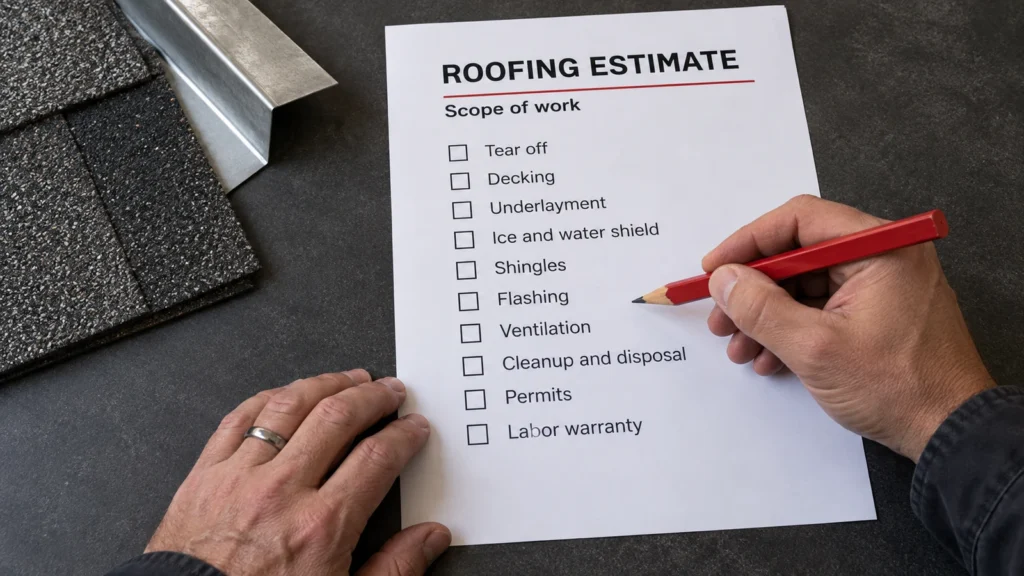
You should be able to find all of this:
- The tear off, and how many layers are coming off.
- The decking, and what happens if some of it is bad.
- Underlayment, named by type.
- Ice and water shield, and where it goes.
- The shingles, by manufacturer and product line.
- Flashing, and whether it is new or reused.
- Ventilation.
- Cleanup and disposal.
- Permits.
- The warranty on the labor.
Anything missing from that list is not missing from the job. It has not been priced, so it turns up later.
What does the tear off line mean?
Tear off is removing what is already up there. The question that changes the price is how many layers.
Some houses have two roofs on them, because somebody shingled over the first one. Two layers means more labor and roughly double the disposal. An estimate that assumed one layer on a two layer house will change once the work starts.
Ask which one yours is. Anybody who has been on your roof knows the answer.
Why does the decking line move?
Because nobody sees the decking until the old roof is off.
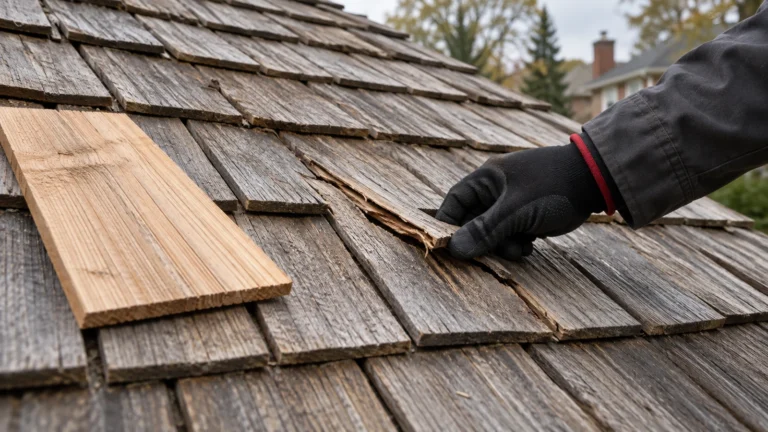
Decking is the wood under everything. Where water has been getting in, it rots, and rotted decking cannot be shingled over. It has to come out.
A good estimate handles this in advance by naming the price per sheet and how replacements get approved. Then the conversation on the day is “we found four sheets” instead of “the price went up.”
An estimate that says nothing about decking is not a cheaper job. It is the same job with a surprise built into it.
What are underlayment and ice and water shield?
Underlayment is the layer between the decking and the shingles. It should be named, because the options are not equivalent.
Ice and water shield is a self adhering membrane. It bonds to the deck where water backs up: the eaves, the valleys and around chimneys and skylights.
It counts for a lot here. Ice dams form when snow melts on a warm roof and refreezes at the cold edge. Water gets pushed back up under the shingles, where gravity was supposed to be doing the work.
Check how far up from the eave it goes. That distance is a meaningful difference between two estimates, and it shows up during a February thaw.
Why does the shingle line need a product name?
Because “architectural shingles” covers a wide range of products.
The estimate should name the manufacturer and the specific line. We install GAF, Owens Corning, CertainTeed, IKO and Malarkey. The differences inside each brand are wide, including impact ratings that count in a hail market.
A line that says “30 year shingles” gives you nothing to compare.
What about flashing?
Flashing is the metal where the roof meets something else: a chimney, a wall, a valley, a vent.
Most leaks people blame on shingles are flashing leaks. The estimate should say whether flashing is being replaced or reused. Reusing old flashing under a new roof is sometimes fine and sometimes how you end up with a leak in a brand new roof.
Why is ventilation on a roofing estimate?
Because the roof is a system and the attic is part of it.
Poor ventilation cooks shingles from underneath and shortens their life, and it makes ice dams worse. If ventilation goes unmentioned, ask what is up there now and whether it is adequate.
Which lines get left off?
Four, and they are the usual reason a cheap estimate stops being cheap.
| Line | What happens when it is missing |
|---|---|
| Disposal. | A dumpster and its haul away appear as an extra. |
| Permits. | You find out at inspection, and the work may stop. |
| Cleanup. | Nails are left in your yard and your tires find them. |
| Labor warranty. | The material has manufacturer cover, the workmanship has nothing. |
The labor warranty is the one to ask about directly. Manufacturer cover protects the shingle. It does nothing about somebody installing it wrong.
How should you compare two estimates?
Put them side by side and compare the lines instead of the totals.
Nine times out of ten the cheaper one is cheaper because something on the list above is missing from it. Add the missing pieces back and the gap closes or reverses.
Then ask both the same question: did you get on the roof? An estimate written from the driveway or off a satellite photo is a guess, and guesses are where surprises come from.
What a good estimate visit looks like
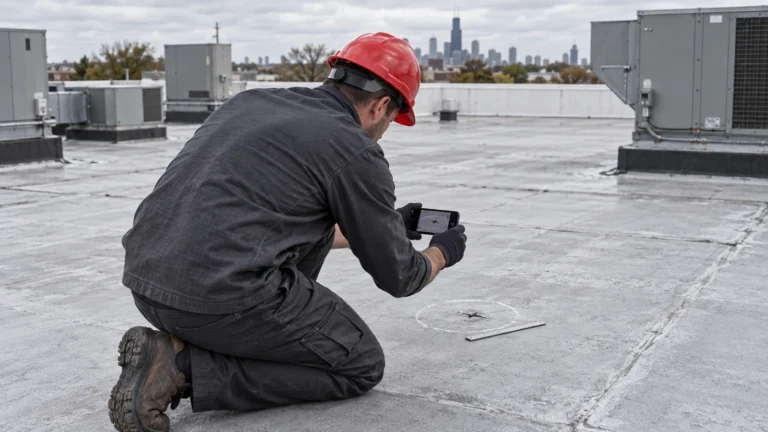
Somebody gets on the roof. They check the siding and the gutters while they are up there. They photograph anything worth showing you.
Then you get the materials, the work and the cost on paper, with time to read it and nobody leaning on you.
The price should not move. A number that drops if you sign tonight was never the price.
That is how ours works. Ask us for a free roofing estimate and you get the visit, the photos and one price in writing with the work spelled out. Call or text us and we will set a time.