
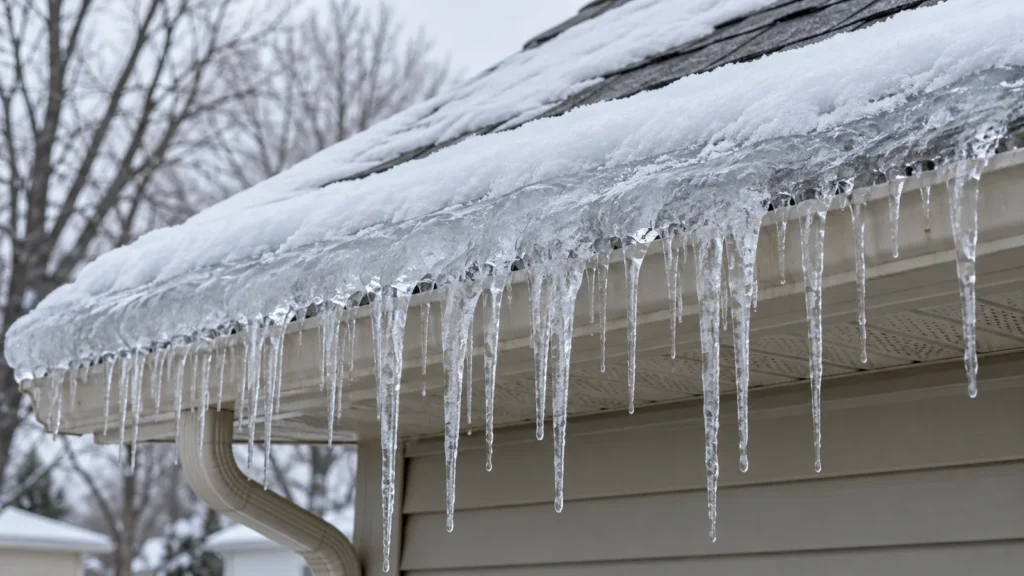
An ice dam forms when heat from inside the house warms the roof and melts the snow on it. The water flows down to the cold edge of the roof, freezes again and builds a ridge of ice.
More melt water then pools behind that ridge. It has nowhere to go, so it backs up under the shingles and can leak into the house.
The snow is only half the cause. The other half is a warm roof deck over a cold roof edge, and in most homes that warmth comes up from the attic.
What causes ice dams on a roof?
Three conditions have to meet. There is snow on the roof, heat reaches the underside of the roof deck, and the air outside is below freezing.
The overhang at the bottom of the roof extends past the warm walls of the house. Nothing heats it from below, so it is as cold as the outside air.
Snow melts on the warm upper part of the roof and the water slides down to that cold overhang. There it freezes, and each round of melting adds to the ridge.
Where does the heat come from?
Usually from the house itself. Warm air finds its way into the attic and warms the roof boards from underneath.
The three usual sources are:
- Air leaks into the attic around recessed lights, bath fans, the attic hatch and pipes.
- Too little insulation on the attic floor.
- Poor attic ventilation, such as blocked vents under the eaves or no vent at the ridge.
Ventilation works by pulling cold outside air in low and letting it out high. A cold attic means a cold roof deck, and a cold roof deck does not melt snow from below.
Do clogged gutters cause ice dams?
No. The cause is heat from the house, and a clogged gutter only makes a dam worse. A gutter packed with leaves fills with ice early and gives the dam a head start right at the roof edge.
The weight is the other problem. A gutter full of ice is heavy enough to bend the hangers or pull the gutter away from the fascia.
Clear your gutters in late fall, before the first hard freeze. It will not stop ice dams on its own, and it does take away the head start.
How do you know you have an ice dam?
Look at the edge of the roof after a few days of snow and cold. A thick ridge of ice along the edge, with long icicles hanging from the gutter, is the classic sign.
A few small icicles are normal. A heavy band of ice with snow piled behind it is the warning.
Inside, look for water stains or peeling paint on ceilings and walls near the outside walls. A damp spot or frost on the underside of the roof boards in the attic points the same way.
What should you do about an ice dam right now?
Pull the snow off the lower few feet of the roof with a roof rake, standing on the ground. Less snow above the dam means less melt water behind it.
For a dam that is already leaking, fill a nylon stocking with calcium chloride ice melt. Lay it across the dam so it melts a channel for the water to drain.
Do not use rock salt, which can harm shingles and the plants below. Do not chip at the ice with a hammer or an axe either, because that breaks shingles.
Never climb onto an icy roof. A fall from a roof edge in winter is far worse than any leak.
How do you stop ice dams for good?
Start in the attic, because that is where the heat comes from. Seal the air leaks first, then add insulation, then make sure the vents are open and working.
Air sealing comes first because insulation alone does not stop warm air. Warm air moves straight through loose insulation and on up to the roof boards.
When the roof gets replaced, ask about ice and water shield at the eaves. It is a self sealing membrane that goes under the shingles along the edge, and it blocks water that backs up behind a dam.
Heat cables along the edge can melt a channel through the ice. They only treat the symptom, though, and they need power all winter.
How do Chicago winters make ice dams worse?
Our winters swing above and below freezing over and over. A sunny afternoon melts the snow, and a cold night freezes it again at the edge.
Each of those rounds adds to the dam. A long cold spell with heavy snow followed by a thaw is when ice dams cause the most leaks.
Older homes with thin attic insulation get the worst of it. So do roofs with complex shapes, where valleys and low spots collect snow.
What if an ice dam already caused a leak?
Water from an ice dam often shows up far from where it got in. It travels along the roof boards and rafters before it drips through a ceiling.
So the stain on your ceiling may not be right below the problem. The fix starts with tracing the water back to where it enters the roof.
Our roof leak repair page explains how we find the source and fix it there, whether that means flashing, shingles or the underlayment below them. Call or text (224) 518-0278 and we will come out and track it down.