
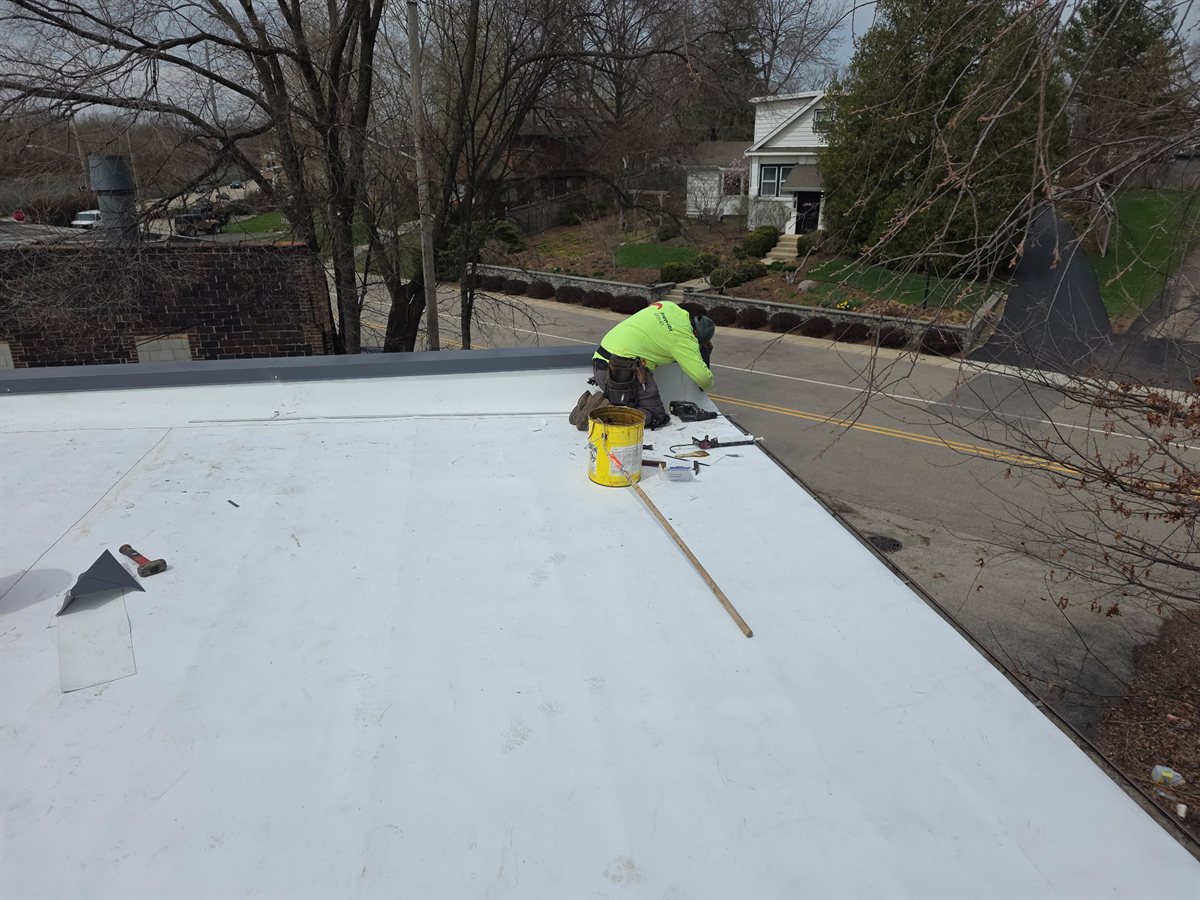

RX crew on a commercial flat roof in the Chicago area
RX ROOFING & CONSTRUCTION · CHICAGO & SURROUNDING SUBURBS

EPDM Roofing for Commercial Buildings.

EPDM is one of the most proven commercial roofing materials you can put on a flat or low-slope building. We install and maintain it on commercial properties throughout the Chicago area, with the seam quality and substrate prep the system needs.

01 / A Proven Commercial Membrane

EPDM Roofing in Chicago and the Surrounding Area.

EPDM is one of the most proven commercial roofing materials available. It’s a rubber membrane that has been installed on flat and low-slope commercial buildings for decades, and its track record in cold-weather climates like the Midwest is one of the strongest of any commercial roofing system. For property owners and managers weighing commercial roofing options, EPDM’s performance history and flexibility in temperature extremes make it worth serious consideration.

RX Roofing & Construction installs and maintains EPDM roofing on commercial properties throughout the Chicago area. We’re licensed, bonded, and insured for commercial membrane work, and we install EPDM with the attention to substrate preparation and seam quality that the system requires.

02 / What EPDM Roofing Is

A Synthetic Rubber Membrane.

EPDM stands for ethylene propylene diene monomer. It’s a synthetic rubber membrane produced in large sheets and installed across flat or low-slope commercial roof surfaces. EPDM comes in black, which is its natural color, or white when a reflective surface is needed for energy performance.

Unlike TPO and PVC, which use heat welding to join sheets, EPDM seams are usually joined with seam tape or adhesive. The quality of the seam connection is still critical to long-term performance, and it takes experienced crews who understand the material and the conditions that affect bonding. That seam work is where careful installation pays off.

placeholder
03 / BUILT FOR MIDWEST WINTERS

EPDM Holds Up to How Cold the Chicago Area Gets.

The Chicago area puts commercial roofing through demanding seasonal stress. Winters are cold, with sustained freezing temperatures and big temperature swings between seasons. Freeze-thaw cycling through fall and spring works on roofing seams, penetrations, and any material that expands and contracts with temperature changes.

EPDM's rubber composition gives it a natural flexibility that holds up well through this cycling. Where more rigid materials can crack or develop stress failures at low temperatures, EPDM keeps its elasticity and continues to seal. That is one of the main reasons EPDM has stayed a major commercial roofing material in cold-climate markets even as newer systems like TPO have grown in use. EPDM also has a long record against UV exposure, with well-established resistance to ozone and UV degradation over decades of real-world performance.

  • FLEXIBLE THROUGH FREEZE-THAW CYCLING
  • KEEPS ITS SEAL AT LOW TEMPERATURES
  • STRONG TRACK RECORD AGAINST UV AND OZONE

04 / EPDM Installation Methods

Three Ways to Install EPDM.

EPDM can be installed three ways, and the right approach depends on your building’s structure, load capacity, and design. We assess the building and substrate before recommending a method, then explain the trade-offs in terms you can act on.

placeholder

Fully Adhered

The membrane is bonded directly to the roof insulation using adhesive. This is the most common method on new and replacement projects. A fully adhered system lies flat against the substrate, keeps a minimal wind uplift profile, and gives a clean finished look. It needs a smooth, properly prepared substrate.

placeholder

Mechanically Fastened

The membrane is secured to the deck through the insulation using fasteners and plates at a set spacing. This method is faster and works well on irregular or uneven substrates where full adhesion is difficult.

placeholder

Ballasted

The membrane is laid loosely and held in place by a layer of ballast, usually washed round stones or concrete pavers. This needs a deck with enough load capacity. Ballasted systems are less common on new construction but may fit certain retrofit situations.

05 / EPDM vs. TPO

The Main Differences Between EPDM and TPO.

If you’re deciding between EPDM and TPO, the most practical differences come down to three things: color and energy performance, the seam system, and track record.

Color & Energy

Standard EPDM is black and absorbs heat. White TPO and white-coated EPDM reflect it. If your building’s cooling load is a real concern, a reflective membrane has an edge. If the building is heated in winter and cooling isn’t the main cost, EPDM’s heat absorption can actually help in colder months.

Seam System

TPO uses hot-air welding. EPDM uses tape or adhesive. Both are reliable when done properly. TPO seams, when properly welded, create a very strong bond. EPDM seams installed by experienced crews with the right products also perform well over time.

Track Record

EPDM has a longer documented performance history than TPO. If track record matters to you as a decision factor, EPDM has it.

Want to compare all three membrane systems side by side? Our team walks you through it during a free inspection and puts the recommendation in a written scope.

06 / EPDM Maintenance

Regular Inspections Keep EPDM Performing.

EPDM roofing benefits from regular inspection and maintenance. Semi-annual inspections help catch seam wear, lap separations, punctures, and drainage issues before they turn into active leaks. When repairs are needed, EPDM is one of the more straightforward membrane systems to repair correctly, which is a practical advantage over the life of the roof.

Written maintenance records also support warranty claims and help property managers plan for capital expenses instead of reacting to problems. We document every visit and hand you a clear report you can pass up the chain. EPDM systems we install carry a workmanship warranty on our labor in addition to the manufacturer’s material coverage.

placeholder

07 / Other Membrane Options

Looking at the Other Commercial Systems?

EPDM is one of several flat-roof systems we install. If you’re still comparing, here’s where to read about the others.

placeholder

TPO Roofing

A white single-ply membrane that reflects heat and lowers cooling loads, with heat-welded seams.

placeholder

PVC Roofing

A reinforced membrane with strong chemical resistance and heat-welded seams, good for restaurants and grease exposure.

placeholder

All Commercial Systems

A full comparison of EPDM, TPO, PVC, and coating systems, with the trade-offs laid out side by side.

08 / Get Started

Get an EPDM Roofing Estimate.

Contact us to talk through your commercial roofing project, or call us at (224) 518-0278. We get on the roof, tell you the truth about what we find, and put it in a written summary either way. We’re available Monday to Friday 7am to 7pm and Saturday 7am to 5pm.