
Your roof deck is the layer of plywood or plank the shingles are nailed to. It is the one part of the job nobody can see until the old roof is already off. That is why a good bid tells you the price per sheet up front instead of a total that cannot move.
A contractor who promises a final number before tear off, with no decking language in it, has a choice to make later. Eat the cost, or hand you a change order. Ask which.
What is roof decking, and why does it rot?
The deck is the wooden surface under everything else. On most homes around here it is plywood or OSB, and on older houses it can be individual planks with gaps between them.
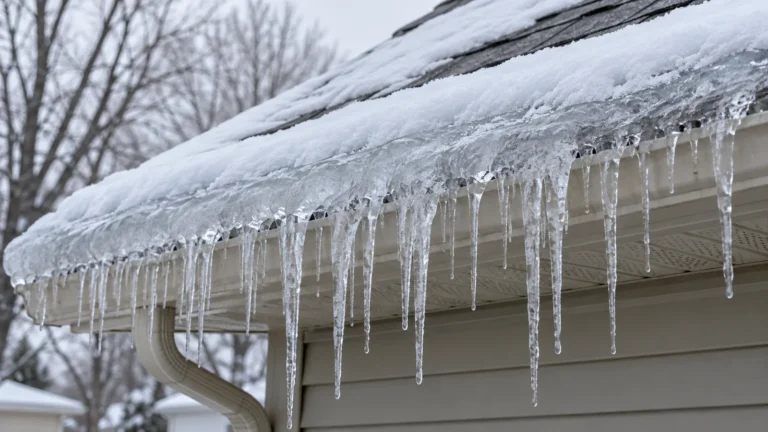
It rots when water reaches it and cannot dry. That happens where flashing has failed, around chimneys and skylights, and in valleys that move a lot of water. It also happens along eaves that have iced up, and under any leak that went unnoticed for a season.
The rot is usually local, which is why it is a sheet count and not a whole roof.
Why can nobody give me a firm figure beforehand?
Because the deck is under two other layers. An inspection from above tells us about shingles and flashing, and an attic look tells us about the underside where it is visible.
Neither shows the sheet in the middle of a slope with a soft patch under an old repair. Some of the deck cannot be seen until the shingles and underlayment come off. Pretending otherwise is how a bid becomes a change order.
What we can do is give you the number that governs it before the job starts: the price per sheet, written down, agreed. Then the only thing that moves is how many, and you see each one.
How much decking usually needs replacing?
On most roofs, not much. Plenty of jobs need none at all.
The ones that need more tend to have a history. An old leak somebody patched, a chimney that has flashed badly for years, or ice damming along a north facing eave. If your roof has had a known leak, expect some decking in that area.
We do not quote a typical number here, because a number pulled from an average is not a number about your house. Yours gets counted, photographed and shown to you.
What should the process look like on the day?
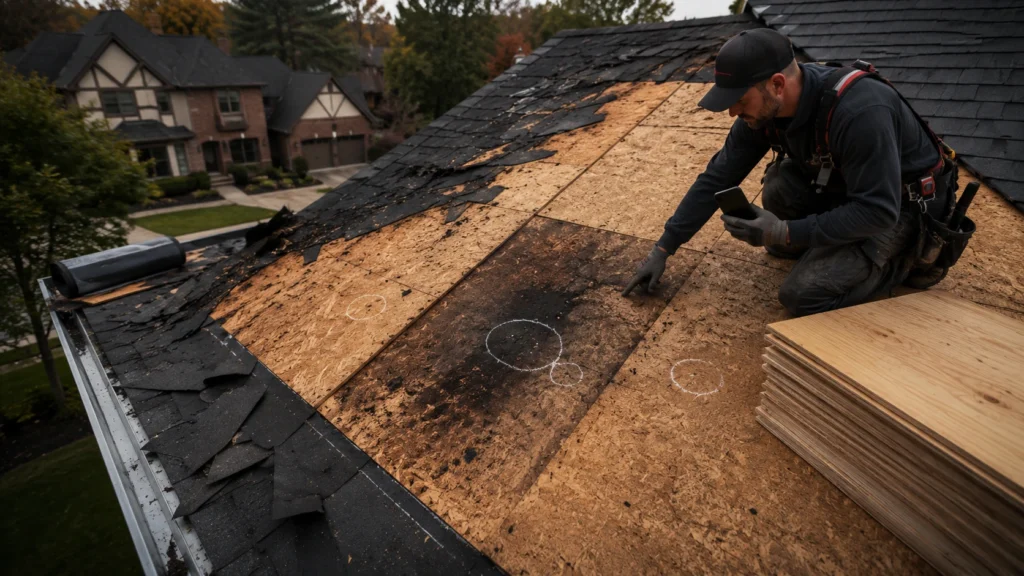
- The old roof comes off down to the deck.
- We walk it. Soft spots underfoot, delamination, dark staining, any sheet that will not take a nail properly.
- Bad sheets get marked in chalk, on the roof, where you can see them.
- We photograph them before anything is covered up.
- New sheets go in, then the ice and water shield and the underlayment.
- The count goes on the invoice at the price you already agreed.
The photographs are the part that protects you. A sheet you were shown is a sheet you can argue about; a line item added after the fact is not.
Is decking covered by insurance?
Sometimes, and it depends on what caused it and what your policy says.
If a storm damaged the roof and water reached the deck as a result, decking is often part of the claim scope. If the deck rotted slowly from an old leak nobody fixed, insurers usually treat that as maintenance. The adjuster makes that call and the photos from step four are what they look at.
Your local building code also has a say. If a deck is in poor enough shape, replacing it is not optional regardless of who pays.
Why this comes up more on older suburban homes
A lot of the housing around Barrington, Palatine, Cary and Crystal Lake went up in clusters. Whole streets share an age and a build style.
Two things follow. Roofs on one street reach the end together. The same detail gets built the same way on every house, so a weak chimney flashing design in 1985 was weak on the whole block.
Homes in this climate get ice damming along the eaves. That is the most common place we find soft decking.
How to stop this being a surprise
- Ask for the price per sheet in writing before you sign anything.
- Ask to be shown the bad sheets on the roof, not described to you afterwards.
- Ask for photos of every sheet replaced.
- Fix known leaks before they become decking. A repair now is cheaper than plywood later.
- Be suspicious of a fixed total with no decking clause. The cost has not gone away, it has just been moved.
What a full replacement includes
Decking is one line in a longer job: tear off, deck repair, ice and water shield, underlayment, new flashing, ridge venting and cleanup. The written scope should name all of it before anyone starts.
Here is what our roof replacement work covers, layer by layer, and what we put in writing before the first shingle comes off.
Call or text (224) 518-0278 for a free inspection. If the roof has years left, we will tell you that instead.